Skip to content

We thinkdifferently.We build AI products that work.

We don’t start with artificial intelligence.

We start with a problem.

We understand it, take it apart and build a solution around it that makes sense.

01Lab

A lab for products, not demos.

NeuroEssence Lab is where we turn complex problems into real technology products.

We research, design, build, measure and iterate again.

Artificial intelligence is part of many of our solutions, but it is never the starting point.

The starting point is always the problem.

How a project moves

  1. 01Problem

    Something that costs someone time, money or wellbeing.

  2. 02Understand

    Talk to the people living it. Measure before having opinions.

  3. 03Design

    Architecture, data, privacy and experience, together.

  4. 04Build

    Software that works outside the meeting room.

  5. 05Measure

    What actually changed for the people using it.

  6. 06Improve

    And back to understanding. The loop stays open.

Measuring and improving lead back to understanding.

AI is a tool. The product is the solution.

02Products

Products that have already left the lab.

Products in sectors that have nothing in common. What they share is the way they are built.

01 Product

NeuroEssence

Neuro-affirming digital health

Status
Live
Stage
In validation

A digital health platform for neuro-affirming clinical and psychosocial support.

It turns complex information about a person into practical strategies and adaptations for everyday life.

Works on an individual profile

  • Cognitive
  • Executive
  • Sensory
  • Emotional
  • Contextual

Areas

  • Education
  • Work
  • Family
  • Personal organisation

What makes it different

  • Personalised adaptations
  • An engine built on more than 6,200 clinical and functional relationships
  • A neuro-affirming approach
  • Privacy reinforced by ZeroDataGate

It is not a chatbot and it does not diagnose. It translates a profile into concrete adaptations and leaves judgement to professionals.
From profile to adaptation. Sensitive data stays behind the gate.

02 Product

BidPilot AI

Tender copilot

Status
Live
Stage
Launching

Preparing a public tender or an RFP means reading hundreds of pages with requirements scattered everywhere. One missed requirement disqualifies the whole bid, and the decision to bid often comes too late.

BidPilot AI covers the whole cycle: it finds the tender, helps decide with data, organises preparation as a team and keeps what was learned for the next bid.

Capabilities

  • Tender radar on official sources, with alerts
  • Tender analysis with page and paragraph citations
  • Go / no-go with disqualification risk
  • Compliance matrix with owner and due date
  • Price simulated with the tender’s own scoring formula
  • Technical compliance matrix
  • Team plan, meetings and guided writing
  • Pre-submission evaluation and export
  • Post-mortem that feeds the company’s memory

What makes it different

  • Every statement links to its page in the tender; no verifiable citation, no verdict
  • ZeroDataGate: personal and client data is replaced before it reaches the AI
  • AI proposes and the team decides: everything is editable and versioned
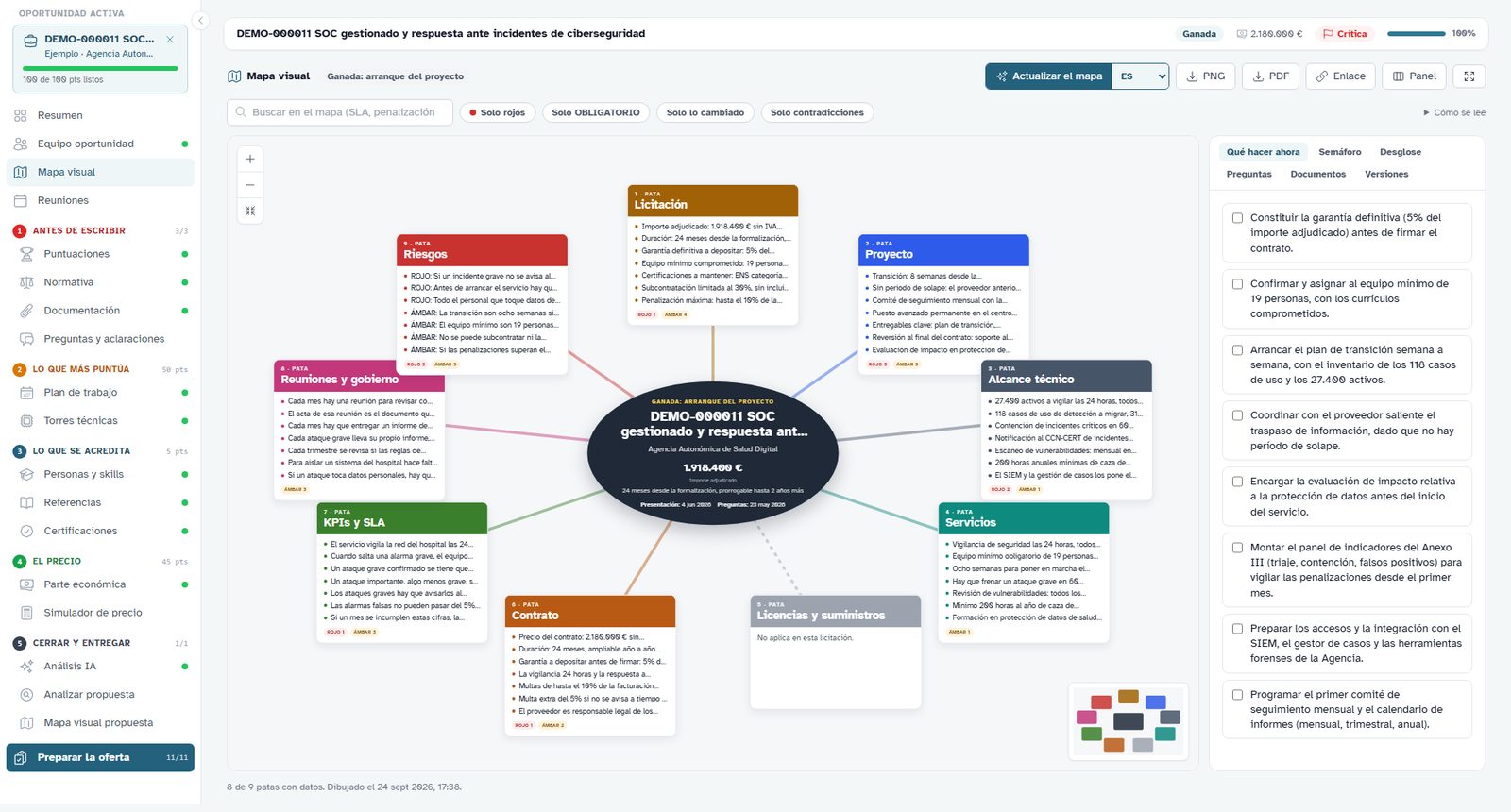
From hundreds of pages to a decision you can defend, with every fact cited to its page.
Visual map of a demo tender in BidPilot AI, with its nine areas and the list of what to do next
Fig. 02 / BidPilot AI

More products, each at its own stage.

The status of each one is always visible. Open a sheet to see what it does and how.

  1. 03

    AI legal guidanceA law firm you can walk through, where each virtual adviser knows her field and cites sources you can check.

    Working MVPPrivate use
  2. 04

    AI video and socialFrom one long video to a week of posts, with human approval before anything goes out.

    MVP deployedPre-launch
  3. 05

    AI presentationsFrom a brief or a document to a consistently styled presentation, exportable to editable PowerPoint.

    Working MVPIn daily use
  4. 06

    MCP server generatorDescribe the system you want to connect to an AI assistant and get an MCP server that was tested before delivery.

    Working MVPInternal use
  5. 07

    IT services operationsCapacity, assignments, margins and know-how of an IT team in a single data model.

    Advanced MVPIn development

02.1In the lab

In the lab

Not every idea becomes a product.

And that’s fine.

We keep experimenting with

  • Agents
  • AI governance
  • Privacy
  • MCP
  • Productivity
  • Automation
  • Observability
  • Interfaces
  • New ways of interacting with models

Experiments and technology in development. They are not commercial products.

Some will leave the lab. Others will simply teach us something.

03Principles

Four principles.

  1. 01. AI with a specific job

    We don’t add AI because it looks good in a slide deck.

    Every model has to solve a specific task and bring a real advantage.

  2. 02. The whole product

    A solution doesn’t end with a prompt.

    We think about

    • Architecture
    • Data
    • Security
    • Permissions
    • Experience
    • Observability
    • Cost
    • Operations
    • Scalability
  3. 03. Multi-provider

    We don’t design products needlessly tied to a single model.

    The architecture can work with different providers depending on:

    • Accuracy
    • Cost
    • Speed
    • Privacy
    • Context
  4. 04. Privacy by design

    Data isn’t protected at the end.

    Privacy has to be part of the architecture from the start.

    We design to reduce the sensitive information that leaves each system.

03.1Architecture

An AI product is much more than a model.

This isn’t the diagram of any specific system. It’s what surrounds any model that makes it to production.

This is what it takes to work on an ordinary Monday.

Hover or focus a node to see what it does.

04About

Hi, I’m Toni.

20+years

Fig. 01 / Founder

Path

  1. Infrastructure
  2. Architecture
  3. Automation
  4. Observability
  5. AI governance
  6. Product
  7. NeuroEssence Lab

I’m Toni, founder of NeuroEssence Lab.

I’ve spent more than 20 years working in IT infrastructure, architecture, automation, observability and technology governance.

In recent years my work has moved more and more towards artificial intelligence, especially towards something I consider essential: how to turn it into real systems that organisations and people can use.

But NeuroEssence Lab also comes from another part of me.

I’m neurodivergent.

Over time I understood that many of the things that for years looked like a strange way of working were precisely my way of solving problems.

I need to understand how things work.

I take them apart.

I look for patterns.

I connect concepts that seem to have nothing to do with each other.

And when I find an interesting problem, I can go very deep into it.

NeuroEssence Lab comes from that way of working.

Not as a company about neurodivergence.

But as a lab built from a different way of thinking.

I don’t try to think outside the box. I usually try to understand why the box exists first.

05Purpose

Designing for the edges improves the centre.

  1. 1 Reduced mobility
  2. 2 Pushchair
  3. 3 Delivery
  4. 4 Suitcase
  5. 5 Bike
  6. 6 Older people

Kerb ramps on pavements were originally designed for people with reduced mobility.

But they ended up helping too:

Who the ramp helped

  • People with pushchairs
  • Delivery workers
  • Travellers with suitcases
  • Cyclists
  • Older people

Something similar happens with neurodiversity. Designing for people with:

  • Greater sensory sensitivity
  • Executive function difficulties
  • Different communication needs
  • Different ways of processing information

forces us to create clearer products, spaces and processes.

And very often that ends up benefiting everyone.

  1. Specific need
  2. Adapted design
  3. Better experience
  4. General benefit

Designing for people who think differently tends to produce better systems for everyone.

06Together

Some things are better built together.

Companies

For organisations with

  • Problems AI could solve
  • Complex processes
  • A need for automation
  • AI governance challenges
  • Neurodiversity-related needs
  • Interest in pilots or POCs

Centres and institutions

For

  • Hospitals
  • Clinics
  • Schools
  • Public administrations
  • Organisations
  • Social organisations

Especially for projects on

Neurodiversity, Accessibility, Processes, Spaces, Adaptation, Digital health.

Investment and partnerships

For

  • Business angels
  • Venture capital
  • Corporate venture
  • Technology partners
  • Commercial partners
  • Impact organisations

There are products at different stages, and NeuroEssence is preparing a pre-seed round.

06.1Contact

Got an interesting problem?

Tell me about it.

I may not have the solution.

But I’ll most likely want to understand it.